The New World Screwworm Fly: How the U.S. Government Is Responding
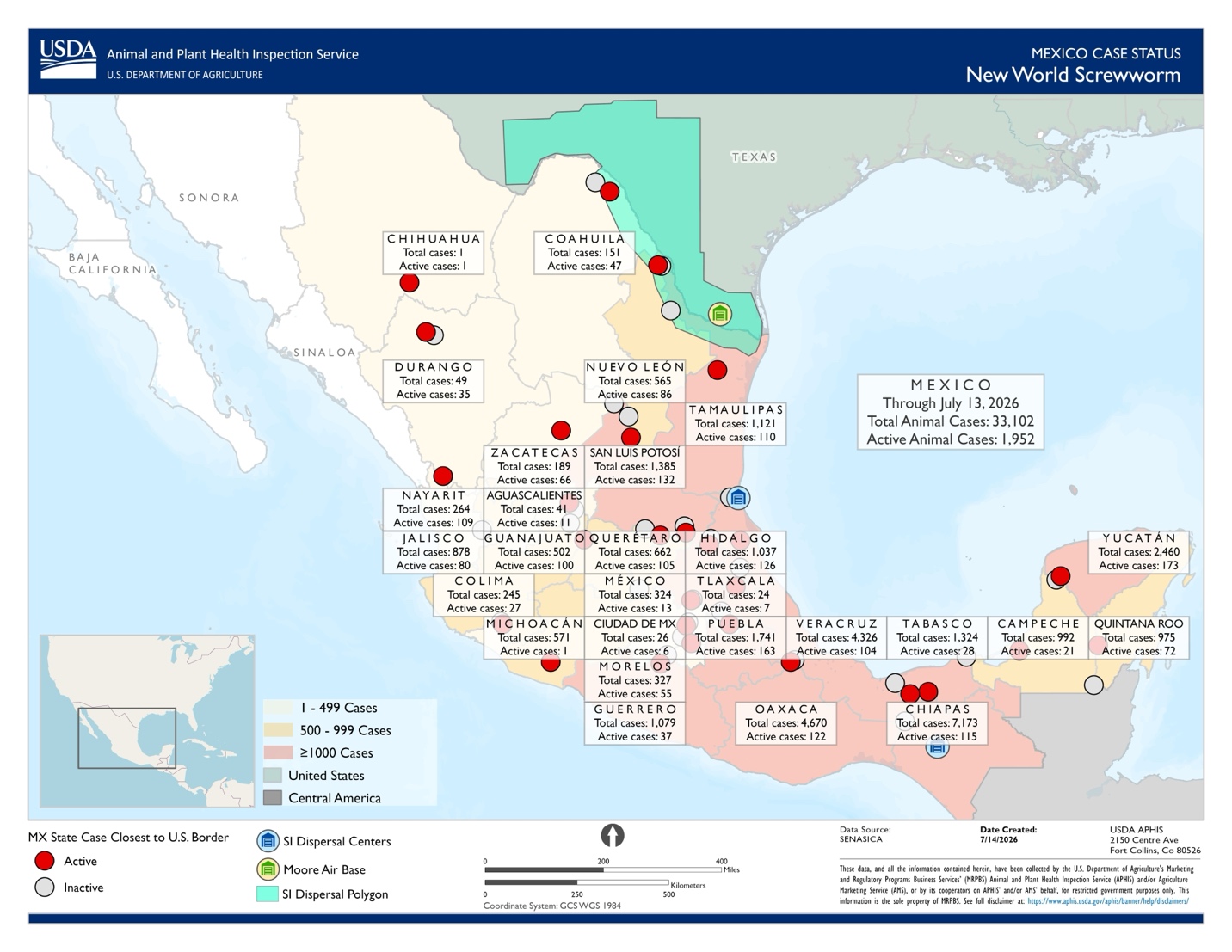
New World screwworm has returned to the United States, prompting an extensive federal and state animal-health response. The U.S. Government is addressing the threat in two principal ways: suppressing and eliminating the regional fly population and making products available to prevent or treat New World screwworm in individual animals.[1][2]
The response combines sterile-fly releases, surveillance, laboratory testing, veterinary treatment protocols, emergency drug authorizations, animal-movement controls and restrictions on livestock imports from Mexico.[1][3]
What Is New World Screwworm?
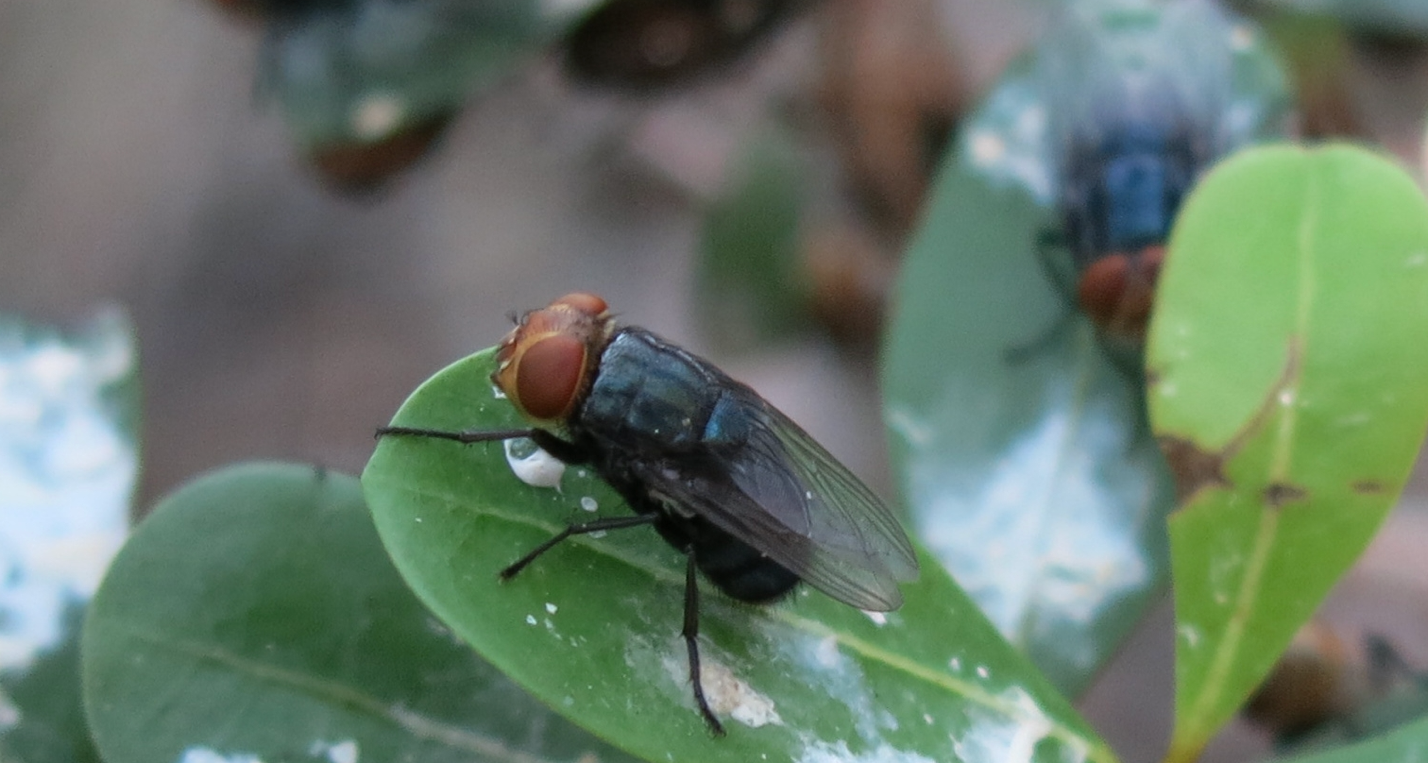
New World screwworm is caused by the larvae of the fly Cochliomyia hominivorax. Female flies lay eggs along the edges of wounds or other openings in the skin. After hatching, the larvae burrow into and feed on living tissue.[4]
New World screwworm can affect horses, livestock, pets, wildlife, birds and, less commonly, people. Possible sites include cuts, punctures, surgical incisions, castration wounds, tick bites, draining abscesses, foal navels and openings around the eyes, ears, nostrils, mouth and reproductive organs.[4]
A wound may enlarge rapidly as the larvae feed and additional flies lay eggs. Without prompt treatment, New World screwworm can cause extensive tissue destruction, secondary infection, severe pain, debilitation and death.[4][5]
USDA confirmed New World screwworm in a calf in Zavala County, Texas, on June 3, 2026. Additional cases were subsequently confirmed. USDA maintains an online dashboard showing current confirmed animal cases and wild-fly detections; that dashboard should be consulted for current locations because the situation continues to change.[6][7]
How the United States Previously Eradicated Screwworm
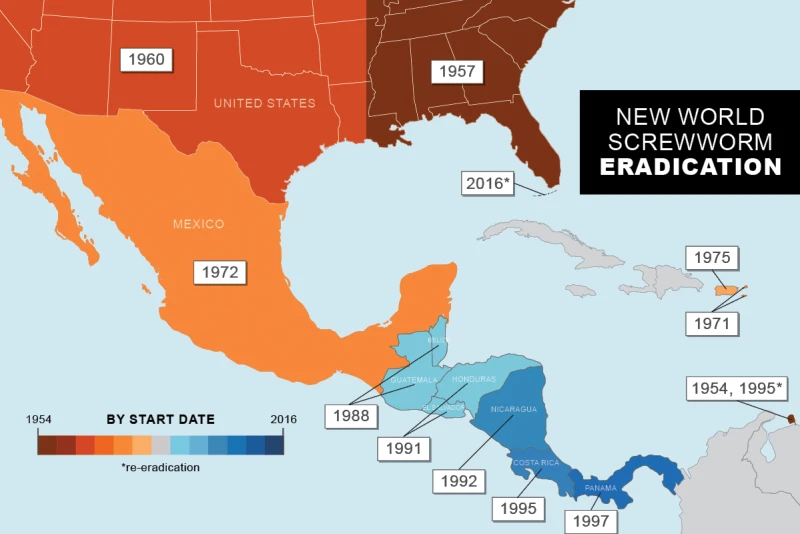
USDA scientists developed the sterile insect technique during the mid-20th century. Screwworm flies were raised in large numbers, sterilized with radiation and released by aircraft. Because female screwworm flies generally mate only once, females that mated with sterile males produced eggs that did not hatch.[8][9]
After a successful 10-week trial on Curaçao in 1954, a full-scale eradication campaign began in the southeastern United States in 1958. The Southeast was declared free of screwworm in 1959. Operations expanded into the Southwest in 1962, and USDA declared indigenous New World screwworm eradicated from the United States in 1966. The principal national effort therefore took approximately eight years, although continued sterile-fly releases and cooperation with Mexico were required to control reinfestations and progressively move the permanent biological barrier farther south.[8][10][11]
Sterile Flies: The Primary Eradication Tool
The sterile insect technique remains the government’s principal method for eliminating New World screwworm.
Large numbers of screwworm flies are raised in specialized facilities and sterilized. The sterile flies are released repeatedly by aircraft and ground-release systems over affected and surrounding areas. When wild female flies mate with sterile males, their eggs do not hatch. Continued releases progressively reduce the reproducing fly population.[9]
Sterile flies cannot produce larvae and do not threaten people or animals. USDA uses surveillance results, confirmed detections, trapping information and modeling to determine where releases are needed and to adjust the treatment area.[1][9]
USDA and Panama jointly operate the COPEG sterile-fly production facility in Panama, currently the only operating New World screwworm production facility in North America. USDA is also expanding production and dispersal capacity in the United States and Mexico, including development of a Texas facility intended to produce up to approximately 300 million sterile flies per week.[4][12]
A single release is not sufficient. Releases must continue over multiple fly generations and cover the full area in which fertile flies may be reproducing.
Treating an Animal Affected by New World Screwworm
Sterile-fly releases suppress the regional fly population, but an animal with larvae in a wound requires immediate, direct treatment.
Treatment generally includes:
- Cleaning and examining the wound
- Physically removing the larvae
- Applying an appropriate larvicide
- Removing damaged or contaminated tissue when necessary
- Protecting the wound against further egg-laying
- Treating secondary infection, pain and other complications
- Providing continuing veterinary care
The World Organisation for Animal Health states that treatment includes wound cleaning, removal of larvae, application of larvicides and measures to prevent secondary infection. Veterinary care is essential to avoid complications.[5]
Systemic medication alone should not be considered complete treatment when larvae are already present. The wound itself must be examined and treated.
Suspected larvae should not be discarded before consulting with a veterinarian or animal-health officials. Samples may be required for official identification and to determine whether additional surveillance or sterile-fly releases are necessary.
FDA Emergency Authorizations for Horses
Few veterinary products previously carried an FDA-approved label specifically for New World screwworm. In August 2025, the U.S. Department of Health and Human Services authorized FDA to issue Emergency Use Authorizations for animal drugs needed to prevent or treat New World screwworm.[13]
An Emergency Use Authorization is not the same as full FDA approval. It permits a specific product to be used for specified species and purposes during the declared emergency.
FDA-authorized options for horses include injectable doramectin, F10 Antiseptic Wound Spray with Insecticide, F10 Antiseptic Barrier Ointment with Insecticide and Negasunt Powder.[2][3]
Doramectin
FDA has authorized Dectomax and Dectomax-CA1, injectable doramectin products, for the prevention of New World screwworm in horses one year of age and older.[14]
For horses, the authorization permits administration when a wound appears or at the time of castration. It does not authorize doramectin as the sole treatment for an existing case, and FDA has not established a defined period of protection against reinfestation.[14]
FDA notes that direct equine studies demonstrating prevention of New World screwworm are not available. The authorization is based on equine pharmacokinetic and safety information, other equine antiparasitic studies and efficacy evidence from cattle.[14]
FDA warns that doramectin should not be used in horses younger than one year or in horses intended for human consumption. Safety has not been established in pregnant or lactating mares, breeding stallions or horses younger than one year. FDA also warns against administering doramectin at or near the same time as ivermectin or moxidectin because all belong to the macrocyclic-lactone drug class.[14]
Horse owners should consult with their veterinarian before using injectable doramectin.
Ivermectin
Ivermectin has been used by USDA as part of a controlled prevention protocol for horses arriving from areas affected by New World screwworm.
When USDA temporarily permitted horse imports from Mexico under enhanced controls, horses were required to be inspected and treated with ivermectin before entering import quarantine. USDA permitted oral ivermectin paste formulated for horses and administered according to its label as an alternative to injectable ivermectin.[15]
This demonstrates that USDA considers ivermectin useful as one component of a short-term, high-risk prevention protocol. It does not establish that routine equine deworming provides continuous protection against New World screwworm.
Ivermectin does not repel adult flies or prevent them from laying eggs in a wound. Drug present in the horse’s tissues may kill susceptible larvae after they hatch, but FDA has not established the duration or reliability of screwworm protection from routine oral ivermectin use in horses.
Frequent or indiscriminate use of ivermectin, doramectin or related products may also increase resistance among equine internal parasites. Preventive treatment should be incorporated into a veterinarian-directed parasite-control program rather than automatically added to every horse’s deworming schedule.[14]
Topical Products
FDA has authorized two F10 products for the prevention and treatment of New World screwworm in horses and other species:
- F10 Antiseptic Wound Spray with Insecticide
- F10 Antiseptic Barrier Ointment with Insecticide
Both contain antiseptic ingredients and cypermethrin and are applied directly to wounds to provide insecticidal activity and help protect the treated area.[2][3]
FDA has also authorized Negasunt Powder for prevention and treatment in horses, donkeys and several other species. Negasunt contains coumaphos, propoxur and sulfanilamide and is applied topically.[2][3]
These products must be used according to their authorized directions. Topical treatment does not eliminate the need for veterinary examination when larvae are present or when a wound is deep, extensive, painful or infected.
Surveillance and Reporting
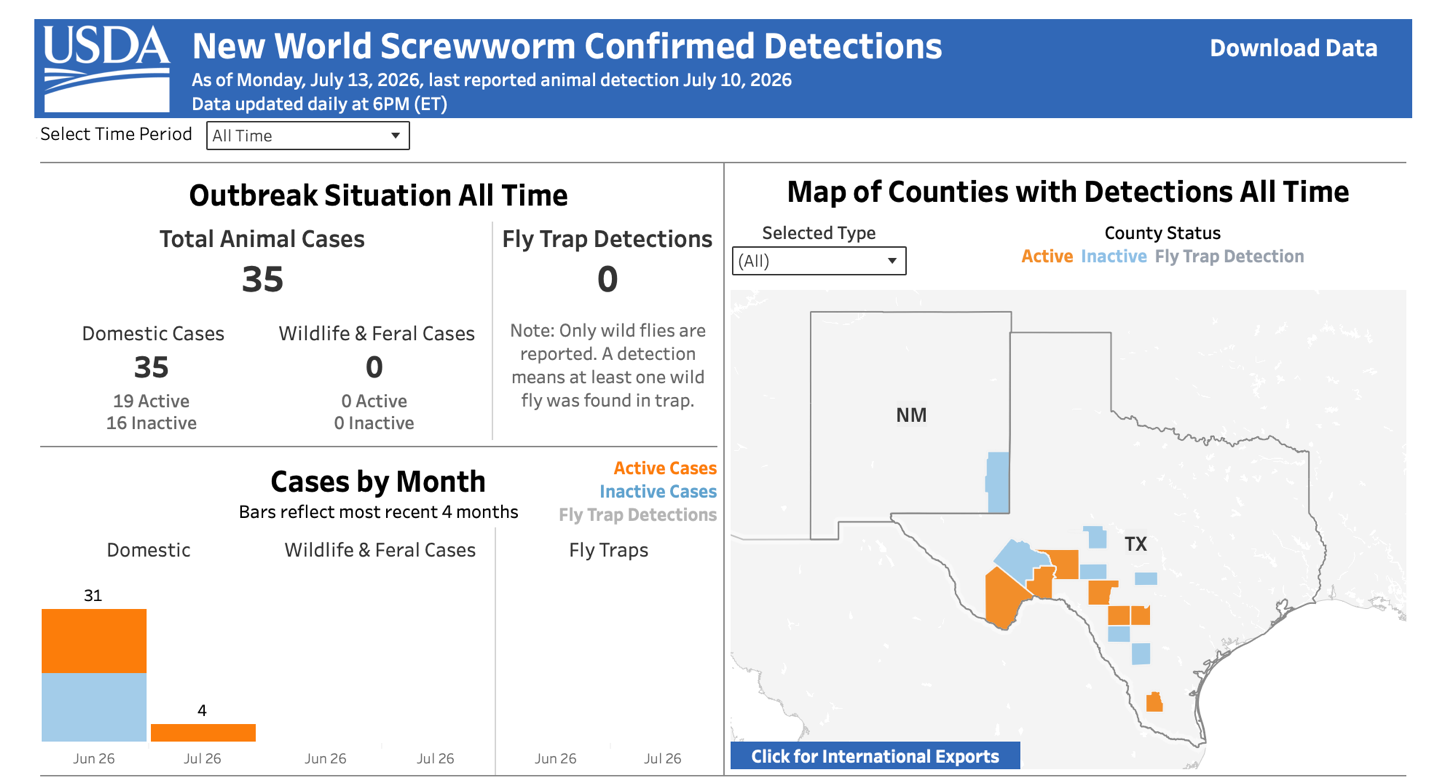
USDA and state animal-health agencies are inspecting animals, collecting and identifying larvae, trapping adult flies, tracing animal movements and examining nearby livestock, pets and wildlife.[1][6]
Confirmed or suspected findings help officials determine where sterile flies should be released and whether the surveillance area must be expanded.
Horse owners should contact a veterinarian immediately when they find larvae or a suspicious wound. Warning signs include:
- Visible larvae or egg masses
- A rapidly enlarging wound
- Bloody or foul-smelling drainage
- Unusual pain or swelling
- An abnormal concentration of flies
- Depression, fever or loss of appetite
Prompt reporting allows the animal to receive appropriate care and gives animal-health officials an opportunity to respond before the fly population becomes more widely established.
Border and Movement Controls
USDA has closed southern land-border ports to imports of cattle, bison and horses from Mexico because of the risk of New World screwworm.[16][17]
Earlier USDA ivermectin protocols describe the precautions used while limited horse imports were temporarily permitted under controlled conditions. Those protocols should not be interpreted as evidence that routine horse importation through the Mexican land border is currently allowed.
States and foreign countries may also impose inspection, certification, treatment, permit or quarantine requirements on horses originating in or traveling through affected areas. These requirements may change quickly following a new detection.
Before transporting a horse, owners should verify current requirements with their veterinarian and the animal-health authorities in both the state of origin and the destination state. International movement should also be confirmed with USDA APHIS and the destination country.
What Horse Owners Should Do
During periods of elevated risk, horses should be inspected daily. Even small wounds, tick bites and irritated areas should be cleaned, protected from flies and monitored closely.
Particular attention should be given to:
- Surgical and castration sites
- Foal navels
- Draining abscesses
- Heel cracks and skin infections
- Eyes, ears, nostrils and mouth
- The sheath, vulva and other moist areas
Horse owners should consult with their veterinarian about appropriate treatment and prevention measures, particularly for horses with wounds, recent surgical procedures, a history of travel to affected areas, or other potential exposure risks.
No single product provides complete protection. Government eradication efforts depend on sterile-fly releases, surveillance, laboratory testing, animal-movement controls, prompt reporting and direct treatment of animals affected by New World screwworm.
The United States has eradicated this pest before. Repeating that success will require sustained government intervention and close cooperation among veterinarians, animal owners and federal and state animal-health authorities.
Sources
- USDA Animal and Plant Health Inspection Service, Stop Screwworm: Unified Government Response to Protect the United States.
- U.S. Food and Drug Administration, Animal Drugs for New World Screwworm.
- U.S. Food and Drug Administration, New World Screwworm: Information for Veterinarians.
- USDA Animal and Plant Health Inspection Service, New World Screwworm Prevention for Animals.
- World Organisation for Animal Health, Frequently Asked Questions About New World Screwworm.
- USDA Animal and Plant Health Inspection Service, Current Status of New World Screwworm.
- USDA Animal and Plant Health Inspection Service, Confirmed Detections of New World Screwworm.
- USDA National Agricultural Library, Introduction: STOP Screwworms.
- USDA Agricultural Research Service, Subduing the Screwworm.
- USDA National Agricultural Library, Southeastern United States Screwworm Eradication Program Records.
- USDA National Agricultural Library, 1958–1969: STOP Screwworms.
- USDA Animal and Plant Health Inspection Service, Sterile-Fly Production and Dispersal Facilities.
- U.S. Food and Drug Administration, HHS Allows FDA Emergency Use of Animal Drugs to Combat New World Screwworm.
- U.S. Food and Drug Administration, Emergency Use Authorization for Dectomax/Dectomax-CA1 in Horses and Other Species.
- USDA Animal and Plant Health Inspection Service, Equine Import Inspection and Ivermectin Treatment Protocol for Mexico.
- USDA Animal and Plant Health Inspection Service, Closure of Livestock Trade Through Southern Ports of Entry.
- USDA Animal and Plant Health Inspection Service, Mexico Confirms New World Screwworm in Nuevo León.